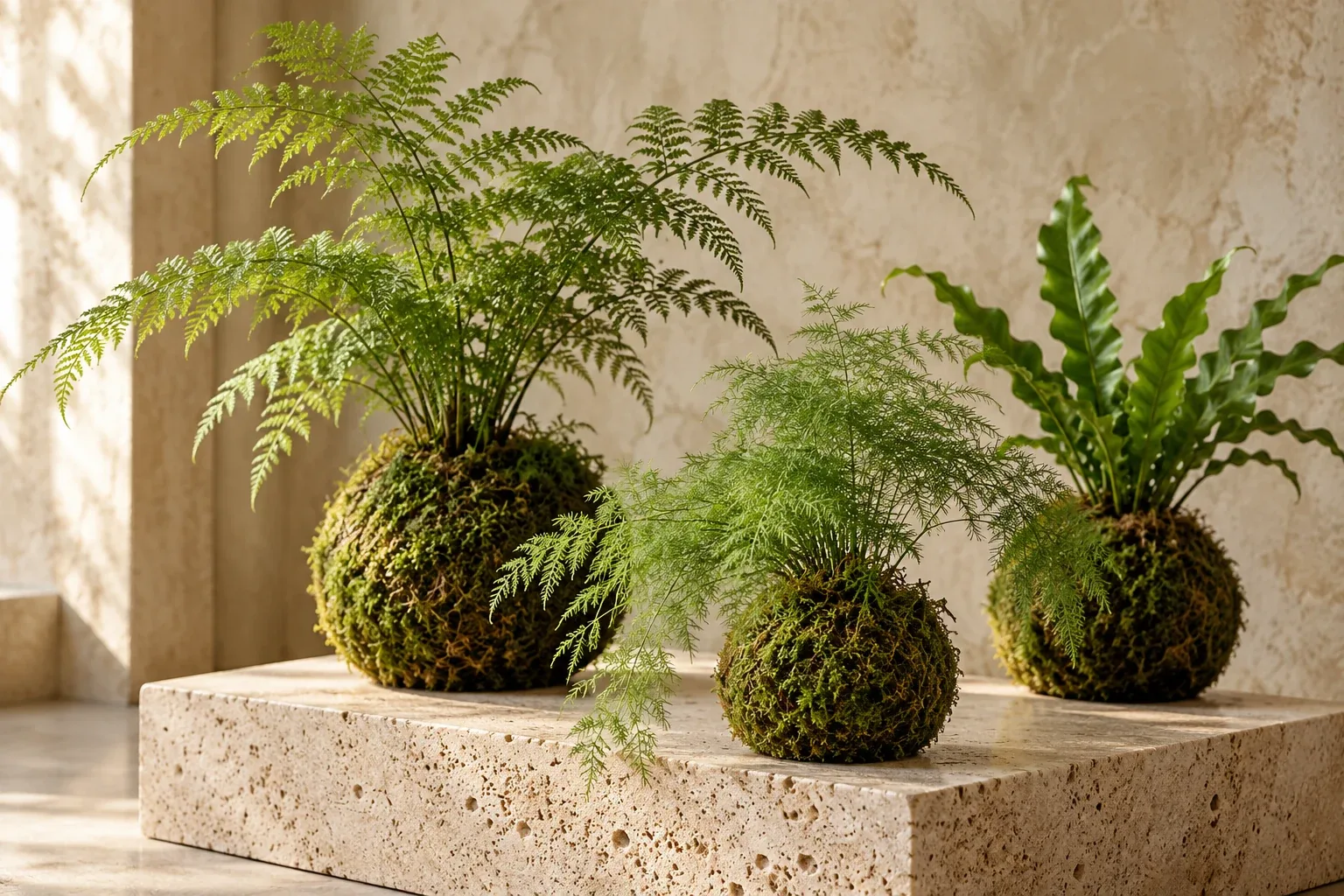
A small living world
A plant doesn’t always need a pot. Kokedama brings roots, earth and moss into a single sculptural form—a small living world that can rest on a surface or hang in the air.
Rooted in Japanese tradition
Kokedama is a Japanese botanical art form with roots in centuries-old bonsai traditions. Its name brings together koke, meaning moss, and dama, meaning ball. The moss-covered root ball becomes the vessel, allowing the plant to be appreciated without a conventional pot.
Penn State Extension traces the technique to nearai bonsai, in which a plant’s tightly established roots and soil retain their form outside a container. Kokedama carries that idea into a moss-wrapped composition, secured with thread or twine.
Earth, moss and the work of your hands
The making is wonderfully tactile: shaping the planting medium around the roots, fitting the moss, then winding the thread to hold the form together. Each pass changes the surface. The result carries a little of the maker’s hand—a gentle irregularity that gives the piece its own character.
For us, the appeal is the meeting of structure and growth. A defined sphere holds a plant whose leaves reach, trail or turn toward the light. That conversation between a deliberate form and a living one is what makes each piece feel like a small sculpture.
Design with the space around it
Think about the space around it as carefully as the plant itself. A quiet background gives foliage room to read. A simple suspension creates a sense of lightness. The shadow becomes part of the composition.
On a surface, or suspended in space
A single kokedama on a shallow dish can become a quiet focal point. Suspended, it introduces another dimension: the space beneath it, the line of the cord and the moving shadow. A group at different heights can suggest a small floating garden.
We like to give each piece breathing room. Against plaster, stone or timber, the texture of moss becomes more apparent. Keep the surrounding arrangement simple enough to notice the relationship between the plant, its rounded base and the space it occupies.
Let care guide placement
Start with the plant’s needs: available light, access for watering and the conditions of the room. Good design makes care possible. A beautiful placement should work for the plant, too.
A living practice
A kokedama remains a living plant, with needs that depend on its species and surroundings. Choose a position for suitable light and easy watering, allow the moss ball to drain before returning it to its display, and protect furniture with a waterproof dish. Build care into the arrangement from the beginning.
Making one is also an invitation to slow down. In a private workshop, we explore the materials, the shape and the final placement together—creating something you can continue to care for after the making is done.
Further reading: The Art of Kokedama — Penn State Extension and Kokedama moss balls — University of Illinois Extension.
Bring an idea to life with us.
Explore botanical workshops